How to Select Stone For Countertops and More

For your Interior Design Project
Selecting stone for a new build is a structural, material, and chemical decision disguised as an aesthetic one. Beyond the visual appeal of movement and color, a slab’s mineralogical composition dictates its porosity, acid resistance, compressive strength, and fabrication tolerances.
In a residential build, stone must resolve architectural context, kitchen ergonomics, wet-area waterproofing, and high-traffic wear patterns.
1. Material Profiles: Geology Meets Performance
Understanding the fundamental trade-offs between geological and manufactured stone prevents costly post-installation failures.
Material | Porosity & Absorption | Acid Resistance (Etching) | Heat & UV Tolerance | Best Architectural Application |
Quartzite | Low (if metamorphic) | Highly resistant | High heat; excellent UV | Working prep islands, outdoor kitchens |
Marble & Dolomite | Moderate to high (easily absorbs stains, like tumeric) | Prone to acid etching | Moderate heat; excellent patina | Primary bath vanities, fireplace mantels |
Soapstone | Chemically non-porous | Non-reactive to all acids | Extreme heat; stable UV | Baking stations, wet bars, hearths |
Granite | Low to moderate | Resistant to most acids | High heat; stable UV | High-volume kitchens, utility zones |
Porcelain Slabs | Near zero (<0.5%) | Impermeable to acids | High heat; zero UV fading | Continuous wall cladding, slim countertops |
Engineered Quartz | Zero (no risk of stains via sauces or spices) | High stain resistance | Low heat (<300°F); resin yellows in UV (don't put a hot pan on it) | Laundry, secondary baths, pantry interiors |
The Quartzite Misidentification Problem
The stone industry frequently mislabels hard marbles or dolomites (such as Super White or Fantasy Brown) as quartzites. True quartzite is a metamorphic rock formed from pure quartz sandstone under tectonic heat and pressure; it scores a 7 on the Mohs hardness scale and does not react to acidic solutions. Dolomite, however, contains calcium magnesium carbonate, which etches upon contact with citrus, vinegar, or wine.
The Glass Scratch Test: True quartzite cleanly scratches glass; marble leaves a faint mark or a powdery smudge.
The Lemon Juice/Muriatic Acid Test: Apply an acid drop to an unpolished corner of the slab. Immediate effervescence or dulling indicates calcium carbonate, meaning the stone requires marble-level maintenance.
2. Room-by-Room Specification Framework
The Primary Kitchen
The kitchen demands a clear hierarchy between the prep surfaces and
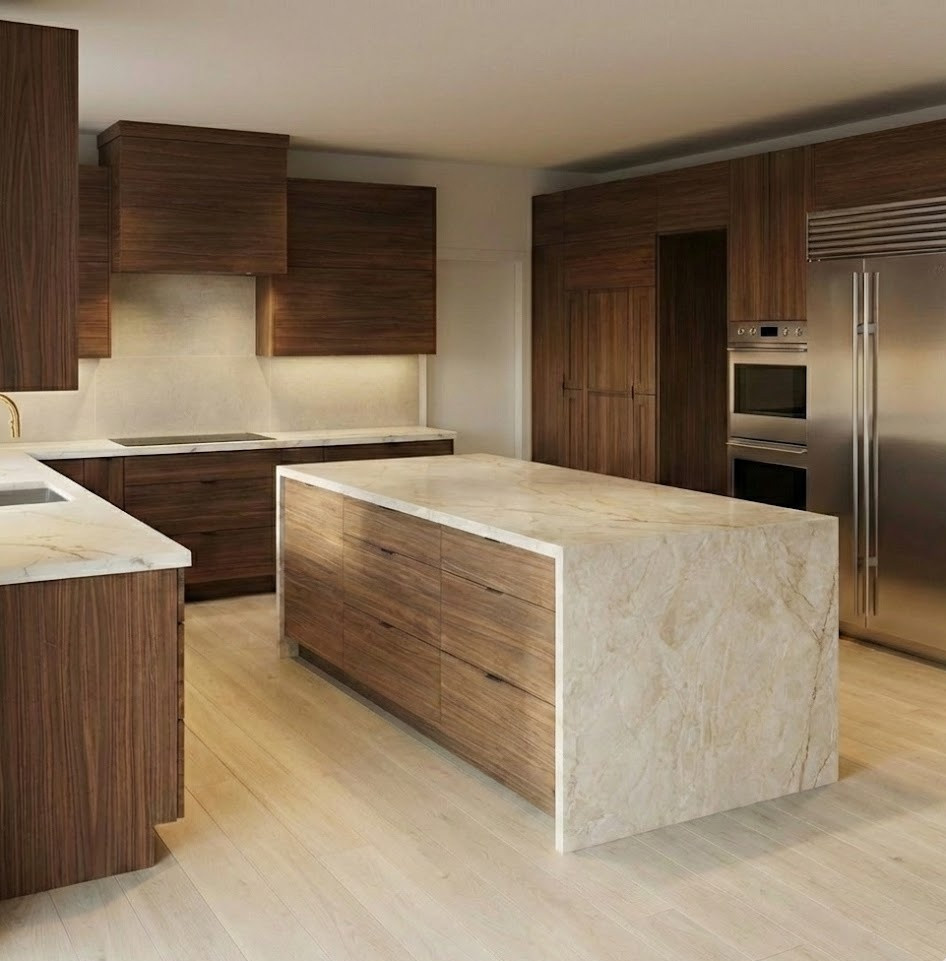
architectural focal points:
The High-Impact Island: Use true metamorphic quartzite (such as Taj Mahal, Mont Blanc, or Perla Venata) for working surfaces. Its high silica content resists hot pans, metal cutlery, and acidic spills.
The Contrast Perimeter: Balance a dramatic natural stone island with a subdued perimeter. Black honed soapstone or deep flamed granites (Nero Mist, Virginia Mist) create a quiet horizontal plane that allows millwork and island veining to take center stage.
Primary and Guest Baths
Wet environments require careful consideration of slip resistance, water chemistry, and mineral exposure:
Honed Marble: Unlacquered, honed calcites (such as Calacatta, Carrara, or Arabescato) develop a soft patina over time. A honed finish obscures minor water etching that would stand out on a polished surface.
Shower Curbs and Benches: Always specify solid stone slabs rather than tiled joints for horizontal shower thresholds to eliminate failure points in the waterproofing membrane.
Secondary & Children’s Baths: Porcelain slabs or premium engineered quartz eliminate maintenance concerns around personal care products, benzoyl peroxide, and chemical cleaners.
3. Surface Finishes: Light Refraction and Tactility
Surface treatments fundamentally alter how light moves through a room and how a stone handles daily wear:
Polished: Delivers maximum visual depth and high color saturation by reflecting light directly. However, it displays scratches, micro-etching, and dust instantly.
Honed (Satin/Matte): The industry standard for balanced luxury. Honing diffuses ambient light, eliminates harsh window glares on large islands, and softens the tactile transition between raw millwork and stone.
Leathered / Brushed: Created by running abrasive diamond-tipped brushes over the surface. This technique strips out softer mineral strata, creating a subtle, topographical relief that hides fingerprints, oils, and surface smudges.
4. Fabrication Precision and Structural Details
A successful installation depends heavily on fabrication parameters and structural clearances:
Thickness (2cm vs. 3cm): Specify 3cm (approx. 1 ¼") slabs for all structural horizontal surfaces. It offers superior cantilever strength and allows for clean, unlaminated edge profiles. Reserve 2cm (approx. ¾") for vertical wall cladding, hood wraps, and fireplace surrounds to minimize structural dead-loads.
Edge Profiles: Steer away from standard roundovers. Opt for an eased edge (⅛" radius) for contemporary lines, or an unsupported mitered aprons (2"–6") to ground an island with visual mass. For mitered edges, verify that your fabricator performs continuous-flow vein folding down the waterfall leg.
Cantilever Tolerances: Natural stone cannot support its own weight over unsupported spans. Any overhang exceeding 10 inches on a 3cm slab (or 8 inches on a 2cm slab) requires concealed steel support plates (minimum ½" cold-rolled steel flat bars spaced every 24 inches on center) anchored directly to the island's structural framing.
Quick and Easy Recommendations: If you don't have the time or resources to analyze your needs, or just unsure, here are some easy recommendations:
Kitchen Island: True Quartzite ──── High Impact, Heat & Knife Work Kitchen Perimeter: Soapstone ──── Quiet Base, Impervious to Oils & Wine Primary Bath: Honed Marble ──── Tactile, Water-Tolerant, Natural Patina Secondary Baths: Quartz/Porcelain ── Uniform, Zero-Maintenance, Budget-Balanced
5. The Yard Walkthrough: A Verification Protocol
Never purchase slabs from digital photographs. Slabs must be viewed vertically in natural daylight before writing a deposit check:
Verify Sibling Slabs: Confirm all slabs for a cohesive run share consecutive bundle and block numbers (e.g., Block 42, Slabs 08 and 09) to guarantee uniform background color and resin clarity.
Bookmatch vs. Slip Match: For large kitchen islands or full-height feature wall backsplashes, specify bookmatched pairs (mirrored adjacent cuts) and inspect how the veining resolves at the focal seam line.
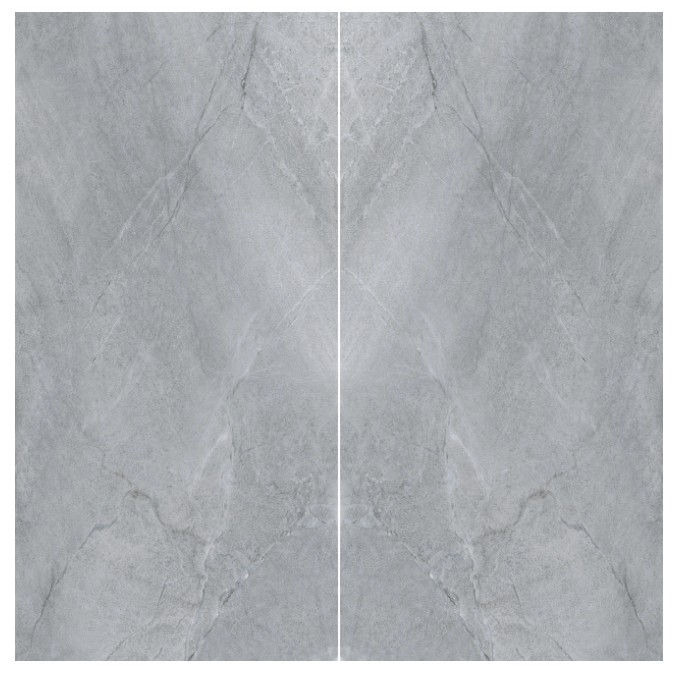
Example of a bookmatch stone. Source: Bedrosian Inspect Structural Fissures vs. Dry Cracks: Run a fingernail across visible lines of movement. A natural fissure is chemically healed with quartz deposits and will not catch your nail; an open dry crack is a structural flaw that risks snapping during transport or CNC cutting.
Evaluate Factory Resin Backing: Most exotic marbles and quartzites ship with epoxy resin and fiberglass mesh backing for structural stability during quarry extraction. Ensure the resin clear-coat on the polished face is free of UV yellowing, pinholing, or uneven curing rings. High end manufacturers like Bedrosian, Cambria, MSI, etc. rarely have concerns.
Stone Specification Matrix
Room / Zone | Recommended Spec | Ideal Finish | Critical Installation Note |
Kitchen Island | True Metamorphic Quartzite (3cm) | Honed or Leathered | Steel plate framing for overhangs >10" |
Kitchen Perimeter | Natural Soapstone or Flamed Granite | Natural Oil / Dry Honed | Specify sink cut-out corners with min. ¼" radius |
Slab Backsplash | Match Island or Perimeter (2cm) | Honed | Bookmatch sequence aligned with cooktop center |
Fireplace Surround | Travertine, Limestone, or Marble (2cm) | Honed / Scabbed | Check zero-clearance insert firebox thermal clearances |
Primary Bath Vanity | Dolomitic Stone or Calacatta Marble | Honed | Penetrating fluoro-chemical sealer applied post-install |
Laundry & Mudroom | Solid Surface / Engineered Quartz | Suede / Matte | Specify non-porous resin base to prevent chemical staining |
The Bottom Line: Timeline, Project Fatigue, and the Value of a Designer
Selecting slabs for a home is far more than a single Saturday trip to a showroom. In a typical 2,000 to 3,000 sq ft custom home or extensive renovation, the process spans multiple distinct zones: kitchen surfaces, full-height backsplashes, primary and secondary bath vanities, laundry/utility rooms, and custom fireplace hearths.
From initial material research and showroom sourcing to on-site slab inspections, digital template reviews, and coordination with your general contractor, homeowners typically spend 40 to 60+ cumulative hours over a 3- to 6-month period navigating these choices. When unguided, this process frequently leads to decision fatigue, costly mid-construction delays, and material mismatches that only surface once the slabs are already cut and glued.
Why Partnering with a Designer Changes the Equation
An experienced interior designer bridges the gap between aesthetic vision, geological performance, and technical trade-offs:
Curated Sourcing Over Infinite Browsing: Instead of wandering through acres of stone yards, a designer pre-screens slab bundles against your millwork, flooring, and lighting plan—shortlisting only consecutive, structurally sound blocks that meet your project's performance criteria.
Geological and Performance Vetting: Designers know which stones are mislabeled in the market, preventing homeowners from installing an acid-sensitive dolomite where they expected an indestructible quartzite.
Precise Technical Specification: From calculating cantilever overhangs and requiring hidden steel plate supports to detailing edge miter depths, reveal margins, and seam placements, a designer produces the exact drawings your fabricator needs to avoid ambiguity.
Digital Slab Layout & Sign-Off: Before a single cut is made, a designer reviews the fabricator’s digital CAD nesting files, ensuring that bookmatched seams align symmetrically with architectural focal points like cooktop backsplashes and waterfall edges.
By shifting the burden of material testing, dimensional coordination, and trade communication to a professional, you eliminate the guesswork and protect your investment. This ensures the stone in your home looks intentional, functions effortlessly, and wears beautifully for decades.

About the Author: Lindsey Tookey is an interior designer dedicated to demystifying high-end design rules for everyday living. She is the co-founder of a full-service residential interior design and project management firm with over 18 years experience serving the Greater Seattle area and Eastside. Ready to pick out your perfect stones for a remodel, renovation, or build? Connect with the team at lindenashdesign.com/contact.



Comments