Interior Design Balance: 4 Essential Rules for Any Space

Have you ever heard someone say, “This room looks so well-balanced,” or felt an effortless sense of calm in a space without knowing why?
Visual balance isn't an accident. It's a trick of scale, weight, and breathing room. Try this: look around your current space and squint until your vision blurs into pure shapes and values. You’ll notice your eyes naturally latch onto the "heavy" anchors—the low-slung sectional, the dark solid-oak dresser, or a dense stone coffee table. Suddenly, the lighter pieces recede entirely, revealing whether your room leans clumsily to one side or sits in harmony.
To ground your space, keep these core rules in mind:
Distribute visual weight through contrast. Pair grounded, blocky silhouettes with "leggy" pieces. A skirted sofa sitting flat on the floor feels heavy; offset it with slim-profile side chairs perched on exposed wooden pegs or a wire-frame coffee table where light and sightlines pass through underneath.
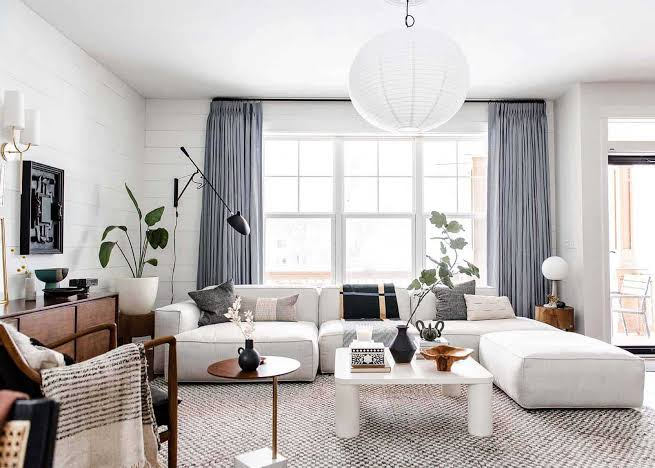
Establish continuity through repetition. Pick at least two recurring elements to carry the eye through the room. This could be echoed materials—like matte black metal on both the lighting fixtures and table bases—or a shared texture, such as bouclé pillows pulling from a nearby wool area rug.
Honor negative space (The 60/40 Rule). A room needs breathing room just as much as it needs beautiful decor. Aim to leave roughly 40% of the room as open floor space. Keep walkways minimum 30 to 36 inches wide so movement feels completely natural, never cramped.
Scale up your accents. Visual clutter ruins balance. Trade out clusters of tiny trinkets for substantial objects: ensure most decorative accents are roughly the size of a soccer ball or larger. For major furniture, anchor each zone by ensuring key pieces occupy about two-thirds of the wall or rug area they sit against.

What About Monochromatic or Multicolored Spaces?
In spaces that abandon a standard neutral palette, balance becomes even more critical:
In monochromatic rooms: Without color contrast to guide the eye, a room can easily fall flat, clinical, or oppressive. Balance must come from tactile texture and tonal range. Offset a smooth linen wall with a nubby bouclé chair, a ribbed wooden sideboard, and high-gloss ceramic accents to let light and shadow do the work of color.
In multicolored rooms: Without structure, multiple hues quickly devolve into chaos. The secret is triangular distribution: never let a bold color stand alone in one corner. If you have an emerald velvet armchair on the left, balance it with emerald tones in a piece of art on the right wall and a jade vase on the coffee table.

Repeating textures and tones for cohesion.. Source: Homes and Gardens
When your sightlines, silhouettes, and scales work in dialogue rather than competing for attention, your room will naturally feel grounded, functional, and effortlessly welcoming.

About the Author: Lindsey Tookey is an interior designer dedicated to demystifying high-end design rules for everyday living. Believing that a well-balanced room should feel just as good as it looks. She is the co-founder of a full-service residential interior design and project management firm serving the Greater Seattle area and Eastside. Ready to bring balance to your next remodel, build, or furnishing project? Connect with the team at lindenashdesign.com/contact.



Comments