Why Home Builders Are Handing the Reins to Designer-Led Project Management


For decades, custom residential construction followed an unwritten rule: the general contractor builds, the interior designer selects finishes, and the homeowner spends nine to eighteen months acting as an overwhelmed, under-qualified liaison between the two.
The inevitable friction points are familiar to every builder/contract manager:
Rough-ins finish before plumbing trim or vanity specs are finalized.
Tile arrives on site only for the lead installer to realize the niche height conflicts with the layout pattern.
Change orders pile up, framing crews stall, and clients experience decision fatigue before drywall is even hung.
Forward-thinking custom home builders and general contractors are moving toward a more efficient, profitable delivery model: Designer-Led Project Management (DLPM).
Integrating end-to-end design and construction management under a unified lead doesn't diminish the GC’s role. It protects your schedule, safeguards your gross margins, and eliminates the administrative drag that pulls site supers off the job.
What Is Designer-Led Project Management?
Designer-Led Project Management combines interior planning, technical procurement, schedule orchestration, and client management into a single oversight stream.
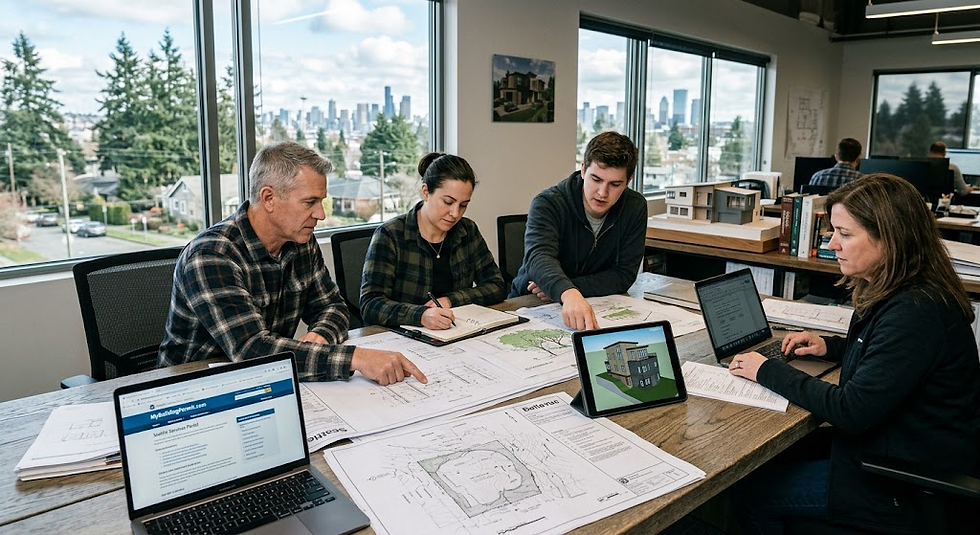
Rather than treating the designer as an aesthetic consultant who drops off a finish schedule and disappears until punch-list phase, the designer functions as an active project manager working directly alongside.
From pre-construction through turnover, the design project manager owns:
Comprehensive Specification Packages: Every finish, plumbing fixture, appliance, tile layout, and millwork detail is specified, dimensioned, and ordered before demo or framing begins.
Visualization and Specifications: 3D designs of visual walkthroughs and photo realistic mock-ups of every room so that all sub-contracts follow the same vision.
Client Buffer & Decision Management: Setting realistic milestones, leading finish reviews, and obtaining formal sign-offs so the GC never has to chase a client for grout color while an installer sits idle.
How It Works in Your Estimate: Designer Fees as a Subcontractor Line Item
One common hesitation builders have when partnering closely with a design-management firm is fee structure: Will this inflate our bid? Will clients resist paying an additional design layer?
In practice, the most seamless delivery model treats the designer's management services not as a separate client invoice, but as an embedded subcontractor fee within your prime contract.
Why Embedding the Fee Protects the Project
Single Contract Simplicity: Clients prefer a consolidated, turnkey contract. When design-led management is folded in alongside mechanical, electrical, and framing scopes, it positions your company as a sophisticated design-build operation.
Markup and Margin Protection: Because the design firm acts as a specialized trade partner, you can apply your standard builder markup or management fee to that scope just as you would for high-end cabinetry or specialty framing.
Clear Lines of Authority: The designer reports directly into the project ecosystem as a committed team member rather than an outside party offering conflicting advice to the homeowner.
Why the Value Far Exceeds the Cost
When builders run the post-job numbers, an embedded designer-PM fee rarely functions as a net expense. Instead, it pays for itself by eliminating the hidden profit drains that quietly erode project margins.
Cost Driver | Traditional Build Process | Designer-Led Project Management | Financial & Operational Impact |
RFIs & Field Clarifications | Supers field dozens of daily texts/calls from subs on fixture heights, transitions, and layout. | Full specification binders and elevation drawings are on-site prior to rough-in. | Saves 10–15 hours/week of superintendent and PM bandwidth. |
Material Delays & Rework | Long-lead fixtures ordered late or arrive with missing rough-in valves. | Procurement schedules aligned directly with the GC's critical path; lead times tracked in advance. | Eliminates trade rescheduling fees and crew downtime. |
Framing & Blocking Errors | Backing for wall-hung vanities, grab bars, or heavy mirrors is missed before drywall. | Precise CAD elevations show exact blocking locations during rough framing. | Eliminates drywall tear-out, re-mudding, and repaint costs. |
Tile & Millwork Execution | Left to field judgment; misaligned grout joints or awkward cuts require tear-outs. | Detailed tile pattern elevations and millwork shop drawing reviews. | Zero disputed finish surfaces; right-first-time installation. |
1. Detailed CAD Drawings Eliminate Site Guesswork
Field corrections eat profits. When a tile setter has to stop and call the super to ask how a mosaic transitions into engineered hardwood, labor hours tick away.
Under designer-led management, trades receive complete CAD elevation packages—including exact valve centerlines, blocking requirements, electrical drops, and full tile indexing. The crew builds directly from the plan rather than interpreting an architect's conceptual sketch on the fly.
2. Time Management & Schedule Preservation
A custom build schedule rarely falls apart all at once; it slips day by day waiting on client selections.
When design is managed alongside the schedule, finish approvals are driven by hard construction milestones. If electrical rough-in starts on Week 10, all decorative lighting specs, junction box locations, and dimming compatibilities are locked by Week 6. Your schedule remains predictable, keeping trade partners aligned and projects on track.
3. Radical Reduction in Friction & Client Burnout
Homeowners build custom homes to achieve a vision, but the hundreds of micro-decisions along the way create immense stress. When friction occurs, clients often look to blame the contractor.
A design project manager acts as an empathetic, authoritative guide for the client. They translate the builder’s technical requirements into straightforward, structured design reviews. The client feels supported, your crew stays focused on building, and final walkthroughs become celebrations rather than negotiations.
Build Stronger, Build Smarter
Building exceptional custom homes requires operational precision. By bringing designer-led project management into your subcontractor team, you transform design from a potential bottleneck into your strongest operational asset.
The result is simple: fewer change orders, faster cycles, happier clients, and protected margins.
About the Author: Lindsey Tookey is an interior designer dedicated to demystifying high-end design rules for everyday living. Believing that a well-balanced room should feel just as good as it looks. She is the co-founder of a full-service residential interior design and project management firm serving the Greater Seattle area and Eastside. Ready to bring balance to your next remodel, build, or furnishing project? Connect with the team at lindenashdesign.com/contact.


Comments